Travel to Greece
Day 9 Corinth - Athens (176 Km.)
(in 56 Km.) Ancient Corinth: Among the archaeological remains that are conserved in the archaeological site of the Ancient Corinth, the seven columns that stand still from the temple of Apollo that Pausanias placed on the street that started from agora and went to Sicion stand out. The temple of Apollo, erected on a height that dominated the agora, was large, 21.5m by 53.8 m, and peripteral, that is, surrounded by a row of columns (28), six on the short sides, 15 in the lengths. Its dating is already confirmed around 540 BC., Each column was a single block and was 7.2 m tall. Inside the colonnade the naos opened, preceded by a pronaos and followed by the opisthodomos, with two columns each, between the antas, and a double cella, whose cover was supported by two rows of columns.
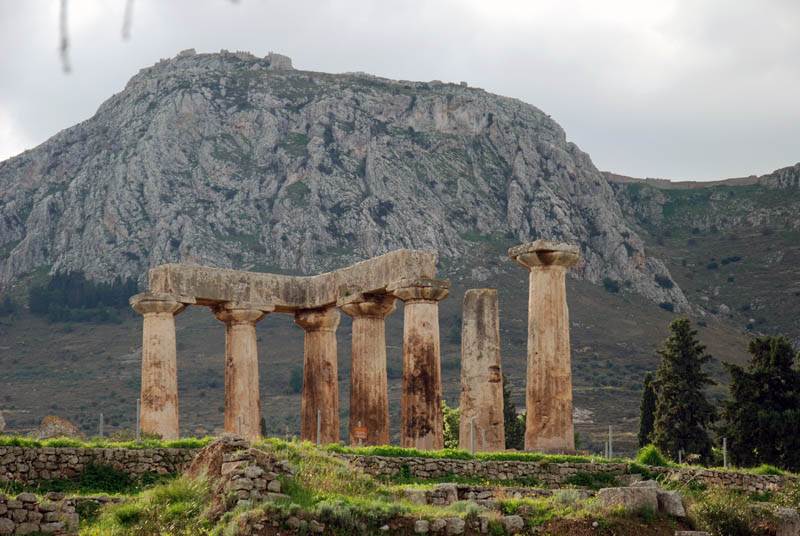
Ancient Corinth - Apollo Temple (and Acrocorinth in the background)
In the site we can also find outstanding remains of the Peirene fountain, the Fountain of Glauke, the Temple of Asclepius, the Roman agora, the Odeion, the theater, the Roman amphitheater, and the so-called Temple E, a Roman temple that Pausanias said that it had been dedicated to Octavia, the sister of Augustus. Although we did not go to visit it, from the ancient Corinth, or from the highway, we see the ruins of Acrocorinth. The Acrocorinth (in ancient Greek Ακροκόρινθος) is a rocky elevation located next to the ancient city of Corinth. It was used as an acropolis in antiquity and the Middle Ages. It was one of the largest Greek acropolis. It reaches a height of 575 meters and has a triple line of fortifications and is one of the most important medieval fortresses in Greece.

Corinth Canal
(in 13 Km.) Corinth canal: The Corinth Canal is an artificial waterway linking the Corinthian Gulf to the Aegean Sea through the Corinthian isthmus, opening this route to Maritime transport and separates the Peloponnese from the Greek mainland. It is 6.3 kilometres (4 mi) in length and was built between 1881 and 1893. It was built by the Hungarian engineer István Türr (1825-1908). Under the plans of Ferdinand de Lesseps, following the former Nero's canal project, Türr directed the works of the Corinth canal since 1881. The canal was inaugurated on November 9, 1893.
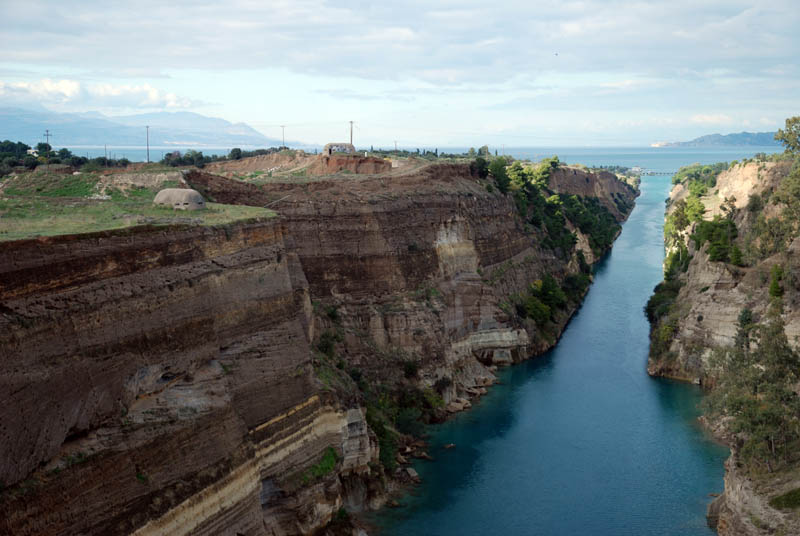
Corinth Canal
The canal avoids to the small boats the 400 km detour around the Peloponnese peninsula, as it is only 21 m wide and 8 m deep. Despite these limitations, about 11,000 ships cross the canal each year, mostly belongnig to tourist routes.
(in 107 Km.) Athens airport: We return the car at Eleftherios Venizelos International Airport, before flying back home.